 FORT WILLIAM HENRY HARRISON Fort William Henry Harrison was authorized by an act of Congress in 1892. The Fort was originally named Fort Benjamin Harrison in compliment to the then President. The name was changed in 1906 to eliminate duplication with a fort in Indiana. The military reservation was acquired by donations through the efforts of Col. C.A. Broadwater (who owned the adjoining Broadwater Hotel and Natatorium), the local Optimist Club, and interested private parties. The Fort was built from 1894 to 1896. In 1895, a detachment of the Hospital Corps from Fort Assinboine south of Havre and several small military posts, which were scheduled to close in the Dakotas, began training at the post. The Montana National Guard began utilizing Fort Harrison for training in 1911, after abandoning Fort Ellis near Bozeman. Fort Harrison was abandoned and left in the charge of a caretaker by the U.S. Army in 1913. The Montana National Guard occupied the Fort in September 1915, beginning the development of the military post we see today. In June 1916, the Montana National Guard was notified by the War Department to mobilize to guard the U.S./Mexican border. With the start of World War I, the Guard was again trained and mobilized in 1917 to protect major railroad and industrial facilities, until they could be dispatched to eastern camps and eventually overseas. After World War I, the Fort became a Public Health Service hospital and eventually a Veterans Administration medical facility (No. 72). During the first years, it was designated as a tuberculosis hospital and expanded to 300 beds. In 1925, the designation was changed to a general medical and surgical hospital. After the October 1935 earthquakes that rocked the Helena area, the hospital facility was closed and the patients transferred to facilities in Washington and Oregon. The Hospital facility was reopened in 1937. The Guard continued to use the reservation for training after the earthquake. During the Second World War, the U.S. Army assumed control of the facility and used it for very new and distinctive military units. These units included the First Special Service Force, the 474th Quartermaster Truck Regiment and the War Dog Training Center (Camp Rimini). Since 1947, the Fort has been used for training by numerous active and inactive combats, support and combat service support units. Numerous major improvements and increased training facilities were completed at Fort Harrison in 2001. Fort Harrison consists of approximately 5,400 acres of training area that includes 10 live fire ranges, a Hand Grenade Qualification Course and a MOUT (Military Operations on Urbanized Terrain) Assault Course. The fort is able to house about 2 battalions of soldiers at a time and in conjunction with Limestone Hills Training Area can support most training requirements. Fort
Harrison is the site of the Montana
State Veterans Cemetery, and the home of the Montana
Military Museum. 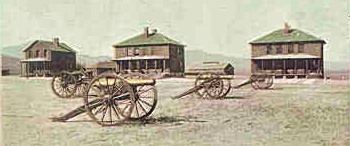 |